Parameter Applications of Precision Agriculture in Tobacco Cultivation— How Variable-Rate Fertilization and Drone Monitoring Truly Improve Uniformity and Combustion Consistency
Traditional uniform fertilization vs variable-rate fertilization
The idea for this article came from a winter fertilization demonstration using drones that I witnessed in July 2025 in Zhongshan, Guangxi. A DJI T60 drone loaded with 50 kg of organic fertilizer lifted off from the edge of the field, flew steadily along the RTK-planned route, and finished spreading over 5 mu (0.33 ha) in 20 minutes. Beside me, an old farmer who had grown tobacco for over a decade said: "I carried manure on a shoulder pole for an entire morning; it finished in twenty minutes, and it spread it more evenly than I can."
That sentence is plain, but it captures the core value of precision agriculture for tobacco — not saving labor, but achieving uniformity. Uniformity directly affects tobacco leaf grade; grade directly determines price; and price ultimately lands in the farmer's income and the stability of the cigarette factory's blend formula. In what follows I will break down this logic chain with data and case studies. My position is clear: precision agriculture in tobacco cultivation is not a luxury — it is a necessity.
1. Why Tobacco Needs Precision More Than Other Crops
Let me first make one thing clear: tobacco's sensitivity to spatial heterogeneity of nutrients far exceeds that of field crops such as rice, corn, and wheat. There are three reasons, and each one points directly to the two core indicators: uniformity and combustibility.
First, nitrogen sensitivity. Tobacco leaf nicotine content, aroma substance accumulation, and the rhythm of mature yellowing are all controlled by nitrogen. If the nitrogen level is too high on the eastern slope of a field, that tobacco leaf becomes greedy for green and ripens late, nicotine runs high, and the leaf gives off heavy off-flavors when burned — industry calls this "usability" collapsing. On the western slope, where nitrogen is low, leaves are thin, color is pale, and aroma is insufficient, so they never make it into high grades. According to national statistics on flue-cured tobacco middle leaves from 2007 to 2013, the coefficient of variation for nicotine content fluctuated between 28% and 37%. In cigarette blending this amplitude is a disaster — formulators have to mix dozens of batches of leaf tobacco to suppress the fluctuation, and every additional percentage point of variation adds to the blending cost.
Second, potassium is the soul of combustion. Whether lit tobacco can sustain smoldering, whether the ash is white, and whether it holds fire strongly are determined by potassium content and the potassium-to-chloride ratio. Potassium ions lower the combustion temperature, making burning more complete and uniform; chloride ions do exactly the opposite and act as a strong flame retardant. Internationally, high-quality tobacco leaves should have a potassium content above 2.5%, and Chinese flue-cured tobacco has long hovered below this standard. Data from the Luliang base in Yunnan in 2014: 92% of samples had potassium content between 1% and 2%, and only 8.3% exceeded 2%. At the Guangxi China Tobacco base, the average potassium content of freshly flue-cured leaves was only 1.98%, with more than half below 2%. In the same batch of samples, chloride content ranged from 0.04% to 1.54%, with extremely large variation. When potassium is insufficient and chloride is unstable, good combustion is impossible. Behind this, besides the inherently low available potassium of southern red soil, a key factor is that fertilization was not precise — broadcasting potassium fertilizer evenly means good patches absorb more and poor patches absorb less, which actually worsens within-field variation.
Third, the field's spatial variation is large. Tobacco is mostly grown on hilly and gently sloping land — Zunyi in Guizhou, Dali in Yunnan, Zhongshan in Guangxi — almost no field is truly flat. Slope, aspect, and soil depth vary dramatically within a few dozen meters. With the traditional practice of evenly broadcast-applying the same amount per mu, tobacco at the hilltop does not get enough to eat while tobacco at the gully bottom gets over-nourished; the resulting batch of leaves differs in height and thickness, let alone combustion consistency — even kiln curing cannot produce uniform results in the same barn.
Precision agriculture is not an optional choice for tobacco — the underlying logic of uniformity and combustibility is that every plant must receive nutrients at highly consistent levels within a reasonable range. If this is not achieved, everything that follows — curing, grading, blending — becomes remedial operation, and the more you patch, the greater the loss.
2. Variable-Rate Fertilization in Practice: From Grid Sampling to Field Execution
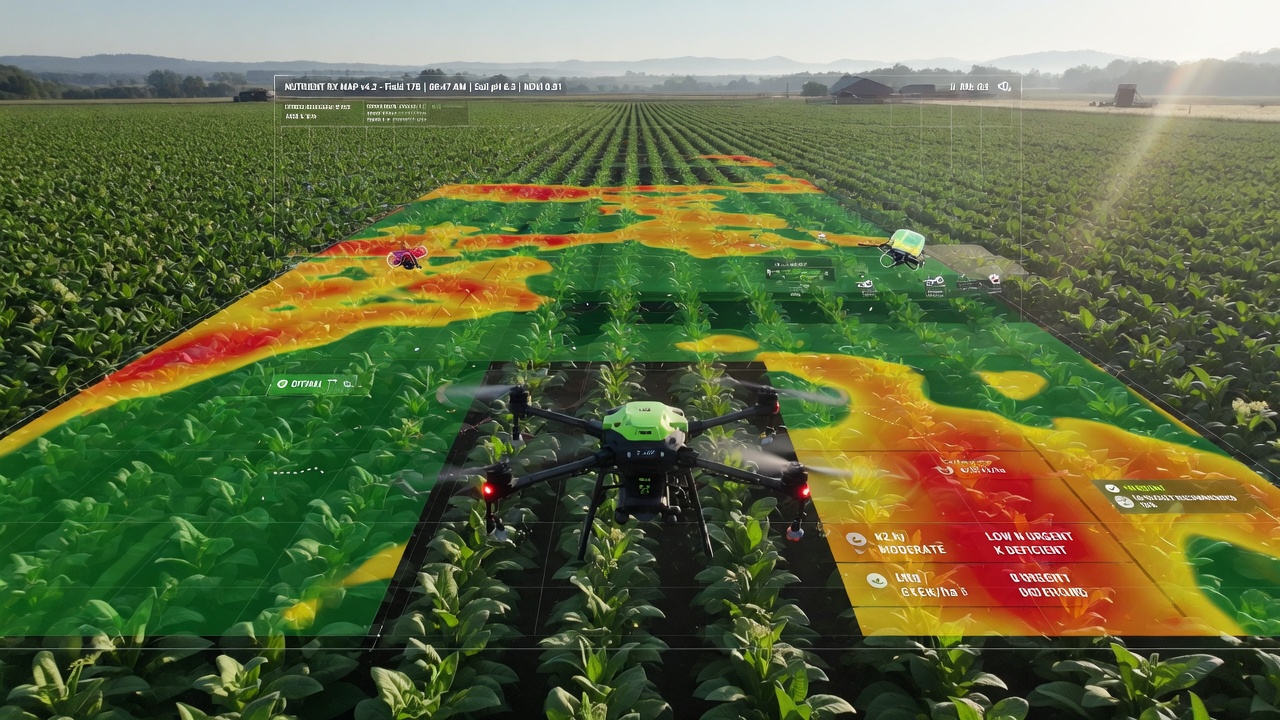
I once watched a complete variable-rate fertilization implementation at the Leyuan Science and Technology Park in Zunyi, Guizhou. It was 2014, a collaboration between the Chinese Academy of Agricultural Sciences and the Zunyi City Tobacco Company of Guizhou Tobacco Province Company. The process is not complicated, but every step has hard parameters. I will split the technical process into four parts and lay out how each step is done, what parameters are used, and what results are achieved.
2.1 How to Define the Sampling Grid
This step has strict geostatistical foundations — the minimum sample size is calculated with the Cochran formula and geostatistical methods. On the plain, one sample can represent about 1.92 hectares, with a maximum sampling interval of 234 meters. But in gently sloping hilly terrain like Zunyi, where the topography is complex, the interval drops directly to 58.2 meters, and each sample represents only 0.73 hectares. A 50-meter by 50-meter grid is the most commonly used scheme; at each sampling point, a mixed soil sample is taken from the tillage layer and tested for available nitrogen, phosphorus, potassium, pH, and organic matter.
Zunyi started this foundational project back in 2011, building a sub-meter GPS differential base station covering the entire tobacco-growing area. By 2016, more than 5,000 soil samples had been collected, producing soil nutrient spatial variation maps covering the whole tobacco region. This map is the foundation of the entire precision fertilization system; the prescription maps and variable-rate fertilization that followed all stand on it. Without this step, everything after it is a castle in the air.
2.2 The Logic of Prescription Map Calculation
The core logic is just four words: supplement according to need. Areas with high soil available nitrogen receive less fertilizer; areas with low nitrogen receive more. The goal is not to apply the same amount of fertilizer across the whole field, but to bring the soil nitrogen supply capacity across the field to similar levels. In that trial, the variable rate was set to a high-low difference of 44%, divided into three management zones — the high-nitrogen zone received 122% of the standard rate, the medium zone 100%, and the low zone 78%.
The prescription logic for potassium fertilizer is similar but with a different goal: potassium is a luxury-consumption element, and as long as soil available potassium supply is adequate, tobacco plants will actively absorb more. The key is to give the whole field sufficient potassium supply, not high in some places and low in others. The prescription map also considers variety factors — different varieties respond very differently to nitrogen and potassium; for example, Yunyan 87 has a higher potassium demand than K326.
2.3 Machinery and Parameters on the Execution Side
At the execution level, a small walking tractor carries a variable-rate fertilizer applicator, equipped with a GPS receiver and an electronic control system to adjust the fertilizer delivery rate in real time. The delivery device itself is a hard-core detail — a spiral fluted-roller feeder that controls the delivery rate by adjusting the roller speed and slot opening. After optimization, the coefficient of variation of delivery rate dropped by 12.74%, and the standard deviation decreased by 15.13%. This figure looks dry, but in the field it means that the amount of fertilizer ejected per meter of tractor travel is stable, with no patches where one section gets more and another gets less. Combined with centimeter-level RTK positioning, the driver does not need to draw lines in advance — he just follows the navigation screen. Operating speed is controlled at about one meter per second to give the feeder enough response time.
2.4 Results Data
Compared with the uniform fertilization farmers are used to: the coefficient of variation of plant height dropped by 29.6%, the proportion of middle-grade leaves increased by 13.05%, output value increased by 4310.65 yuan per hectare, and fertilizer use was actually reduced by 4.6%. The further gentle-slope trial data in 2015 were even brighter: nitrogen fertilizer saved 10.7%, phosphate fertilizer saved 10.3%, and fertilizer cost was cut by 86.3 yuan per hectare; yield increased by 10.6% on average, the share of high-grade leaves rose by 7.3%, output value rose 14%, and net benefit increased by about 5141 yuan per hectare.
My view is this: the value of variable-rate fertilization for tobacco lies not in saving that bit of fertilizer, but in pulling the growth state of the leaves into alignment. Once uniformity goes up, a single kiln cures leaves of the same level, grading losses fall, and industrial usability rises — that is the big picture. Note the detail of that trial: the proportions of high-grade and low-grade leaves both fell in sync, while the proportion of middle-grade leaves rose sharply. That means traditional uniform fertilization let good soil overgrow into off-grade leaf and poor soil stay malnourished below middle grade. Variable-rate fertilization pulls both ends toward the middle, concentrating overall quality.
In 2025, the intelligent drone fertilizer-spreading system in Zhongshan, Guangxi, pushed this matter another big step forward. It integrated RTK positioning, multispectral sensors, and AI algorithms to generate "one field, one strategy" prescription maps. Drone spreading uniformity reached over 98%, the per-mu fertilization error was controlled within plus or minus 0.5 kg, and efficiency was 20 times that of manual work. A 140-mu tobacco field of one household in Huilong Town achieved an average output value of 5000 yuan per mu. Behind that 5000 yuan is not cost saving — the tobacco leaf grade went up.
3. Drone Monitoring: What You See Is Not Just a Colored Picture
Many places use drones to patrol fields — they fly a lap, produce an NDVI image where green means good and red means problems, and then nothing happens. That treats the tool as if it were the goal. Truly meaningful drone monitoring builds a closed loop from spectral data to agronomic decisions. Below I split the discussion into four parts: hardware selection, index selection, calibration and validation, and combustibility prediction.
Hardware Selection
The DJI Mavic 3M multispectral version is currently the most practical choice — four narrow-band sensors (green 560 nm, red 650 nm, red-edge 730 nm, near-infrared 860 nm), centimeter-level RTK positioning, and a built-in sunlight sensor that automatically calibrates radiance. At flight altitudes of 50 to 80 meters, ground resolution is 2 to 5 centimeters, enough to see the canopy differences of every tobacco plant.
Tobacco has three key monitoring periods: 7 to 15 days after transplanting, check survival rate and missing plants; from rosette to vigorous growth stage — 35 to 60 days after transplanting — do nutrient diagnosis; at maturity, do quality prediction and optimal harvest timing judgment. The Dali Prefecture Tobacco Company in Yunnan used the P4M multispectral drone to collect data, analyzed the relationship between vegetation indices and chlorophyll content, and built a localized inversion model. Zhongshan in Guangxi, meanwhile, overlaid the three-dimensional electronic maps generated by drone surveying onto soil fertility data to form a comprehensive digital archive of tobacco fields.
Which Core Index to Choose
Tobacco leaves are large and planting is concentrated, so NDVI saturates easily during the vigorous growth stage — the whole field is dark green, values are all above 0.8, and differences are invisible. NDRE (normalized difference red-edge index, formula: near-infrared minus red-edge divided by near-infrared plus red-edge) is more sensitive to chlorophyll and nitrogen, making it a better index for tobacco nutrient diagnosis. The red-edge band happens to fall in the transition zone between the chlorophyll absorption edge and the near-infrared reflectance plateau, where it is extremely sensitive to changes in chlorophyll content.
More advanced is fluorescence sensing technology. France's Multiplex 3 excites leaves with red light at 630 nm and ultraviolet light, then measures chlorophyll fluorescence and epidermal flavonoid fluorescence, calculating the nitrogen balance index NBI as SFR_R divided by FLAV. In 2025, field trials in the Perugia region of Italy used NBI as the decision basis for variable nitrogen application. In one commercial field of 2.04 hectares, divided into three nitrogen management zones, the dose difference between the high-nitrogen and low-nitrogen zones was 44%. As a result, the in-field nitrogen coefficient of variation dropped from 23.5% to 7.9% — a 66% reduction. The precision fertilization rate in the high-nitrogen zone reached 99.98%. Re-examination 16 days after fertilization showed the NBI values of each zone trending toward balance, proving that variable nitrogen application works.
The Italian team also built a linear model between NBI and the nicotine content of cured leaf, with R² equal to 0.72. This means that flying a fluorescence sensor about two months after transplanting can predict the final nicotine content range of that field. They also developed an improved index, mNBI, equal to NBI divided by the square of days after transplanting, and combined it with meteorological variables such as temperature and solar radiation to build a partial least squares regression model with prediction accuracy R² of 0.72 and RMSEP of 2.73 mg per gram. Accumulated solar radiation and growing degree days were the two most important meteorological variables.
Remote Sensing Data Must Be Ground-Calibrated
I have seen cases where a fertilization plan was produced from a single drone flight, and when SPAD values were measured, the model error was close to 20%. The approach of the Dali Prefecture Tobacco Company is correct — coupling drone multispectral data with ground SPAD chlorophyll meter readings and leaf nitrogen content sampling, and building the model from all three together. Using remote sensing data alone for nutrient diagnosis, changes in light conditions, variety differences, and growth stage differences all introduce error. Ground anchor points should be at least 10 sampling points per 20 mu, covering areas of different growth vigor, so the remote sensing model can be calibrated for use under local conditions.
Combustibility Cannot Yet Be Predicted Directly by Remote Sensing
Combustibility is the smoldering fire-holding ability of tobacco after ignition. The traditional test method is to cut 30 mm by 20 mm pieces from the leaf tip, middle, and base, ignite them with an electric heating head, and record the time from smoldering start to extinction of the last fire point. The Zhengzhou Tobacco Research Institute has already developed an automated testing device that uses a camera to capture combustion images in real time and automatically determines start and end. Near-infrared spectroscopy can also rapidly predict smoldering time: after grinding and sieving leaf samples, near-infrared spectra are collected and a partial least squares model is fitted to smoldering time.
But these methods are currently laboratory or production-line tests and cannot yet provide real-time field assessment. Drone hyperspectral imagery can invert leaf potassium and chloride content, and current accuracy is already sufficient to guide field management. My recommended approach is a dual closed loop: field drone nutrient diagnosis guides variable potassium application and chloride control; after harvest, representative samples are tested for smoldering time by near-infrared rapid testing, and the results feed back to calibrate the remote sensing model for the next season. In this way, a self-iterating precision improvement cycle is formed.
4. The Underlying Logic of Combustion Consistency
Uniformity and combustibility are often mentioned together, but their relationship deserves deeper examination.
Uniformity — plants growing evenly, with consistent leaf size, thickness, and color — is the physical precondition of combustion consistency. But uniformity is not the end; the real goal is for every plant's potassium content, chloride content, and sugar-to-alkaloid ratio to fall within the same quality interval.
The quantitative indicator of combustion consistency is the potassium-to-chloride ratio. Generally, a ratio above 4 is considered good combustibility, and high-quality Chinese leaf samples average between 5 and 10. In reality, the coefficient of variation of the potassium-to-chloride ratio across national flue-cured tobacco is as high as 51% to 80%, and the coefficient of variation of chloride content is 42% to 105%. This means within one batch, some leaves burn fast with white ash and others go out midway with black ash. Cigarette factories can only patch this through blend formulation, but the larger the raw material fluctuation, the higher the blending cost and the harder it is to guarantee product consistency. Industry requirements for raw leaf stability keep rising — once a cigarette brand grows large, a single formula easily produces hundreds of thousands of cartons per year, and raw material uniformity directly determines whether the brand can maintain a stable taste.
The transmission path by which precision agriculture improves combustion consistency can be written as a chain: precise grid sampling produces a soil nutrient spatial map, which feeds the prescription map algorithm, which drives variable-rate fertilization equipment to control nitrogen, increase potassium, and limit chloride, which raises the consistency of plant growth, which in turn reduces spatial variation in chemical composition — especially potassium, chloride, and nicotine — bringing the potassium-to-chloride ratio toward uniformity and ultimately improving combustion uniformity.
On this chain, variable-rate fertilization is the driving engine and drone monitoring is the feedback system. The Italian experiment proved the first step — the nitrogen coefficient of variation fell from 23.5% to 7.9%, significantly improving chemical composition consistency. The Zunyi experiment proved the middle step — the coefficient of variation of plant height fell 29.6% and the proportion of middle-grade leaves rose 13%. The Zhongshan drone fertilization proved that potassium fertilizer can be spread evenly to over 98% precision. But for the final step, direct quantification of combustion consistency, public data are indeed still scarce.
My judgment is that in the next three to five years, with the popularization of hyperspectral drones and automated combustion testing devices, direct field assessment of combustion consistency will become reality. The Zhengzhou Tobacco Research Institute already holds relevant patents, and the accuracy of hyperspectral drone inversion models for potassium and chloride content improves year by year. The industry has not yet made combustibility a routine indicator for evaluating precision agriculture results, but I believe this gap will soon be filled. Once combustion consistency can be mapped in the field in real time like NDVI, the return on investment of precision agriculture in tobacco will be proven once again.
5. Problems I Saw in the Field and My Clear Views
First, do not worship equipment. Many tobacco regions bought a pile of drones and sensors that end up gathering dust in warehouses. The reason is not that the equipment is bad, but that nobody knows how to process the data. A multispectral image is taken, but no one can stitch orthophotos, compute vegetation indices, or generate prescription maps. The bottleneck of precision agriculture has never been hardware; it is the capability gap between data and decisions. The approach of Zhongshan Tobacco is worth learning — they established volunteer service teams of party members and tobacco technicians to run mobile classrooms, teaching route planning, equipment debugging, fertilizer ratio design, and data processing hand in hand. Without this supporting capability, hardware is just scrap iron. Building this capability layer needs not money but time — at least one to two complete growing seasons of hands-on practice.
Second, variable-rate fertilization is unfriendly to individual smallholder farmers, but the cooperative model can break through. Zunyi's experience speaks to this. Cooperatives purchase equipment centrally, conduct unified aerial application and unified fertilization, and farmers pay for the service. Chen Xingang, a tobacco farmer in Pinghai Village, Bofang District, said that after mechanization, labor used in tobacco growing dropped from 31 workers to 21, and in the flat dam area it could even reach 18 — an average reduction of 10 workers means about 1000 yuan of extra income. Farmers in Yuqing County said, "Growing tobacco is now far less worrying," with plowing, transplanting, fertilization, and pest control all entrusted to cooperative service teams. Without cooperatives, individual households can neither afford variable-rate applicators nor learn prescription map software. Zhongshan's cooperative agricultural machinery services already cover more than 10,000 mu of tobacco fields and rice paddies, achieving full mechanization coverage from plowing to plant protection.
Third, integrated water and fertilizer may be the next explosive growth point of variable-rate fertilization. At present, most variable-rate fertilization is solid fertilizer spread by machine or drone. But tobacco is equally sensitive to water, especially during vigorous growth and maturity. The southeastern tobacco region is already promoting water-fertilizer integration, combining drip irrigation with variable-rate nutrient supply, with precision achievable down to the individual plant level — the flow rate of each plant's drip emitter can be adjusted separately. The downside is a high one-time investment: drip irrigation facilities cost about 300 to 500 yuan per mu, plus automatic control valves and sensor systems, so the initial investment is larger. But from a long-term benefit perspective, water-fertilizer integration can raise fertilizer use efficiency from about 35% under traditional broadcasting to over 55%, greatly reduce nitrogen and phosphorus loss, and, because nutrients and water are regulated in sync, its potential for quality improvement far exceeds that of solid variable-rate fertilization.
Fourth, I have a clear position on potassium fertilizer. Potassium fertilizer for tobacco must avoid chloride-containing potassium fertilizers and prioritize potassium sulfate or potassium nitrate. Test data from the Guangxi China Tobacco base show that some samples' chloride content exceeded the standard at 1.54%, and chloride in irrigation water individually reached as high as 138 mg per liter. Using potassium chloride directly raises leaf chloride content and discounts combustibility. Variable-rate potassium application not only solves the quantity problem, but more importantly achieves precision in quality by matching variety and field characteristics — which field needs more potassium supplementation and which field needs careful chloride control. Even within the same field, soil water-soluble chloride content can differ by several times between zones; only variable-rate application can achieve precise matching.
6. Precision Agriculture Turned Tobacco Growing from Experience into Engineering
What I saw in Zunyi and Zhongshan was not a simple stacking of new technology onto agriculture, but a change in the way of thinking. Growing tobacco no longer depends on "this village's old hand added ten more jin of fertilizer this year," but on exact dosages calculated from grid sampling data, remote sensing vegetation indices, and prescription maps. This does not replace the experience of old tobacco farmers; it turns the intuitions they cannot articulate — "tobacco on this slope always grows worse than at the gully" — into parameters that can be quantified, replicated, and verified.
Variable-rate fertilization presses the nitrogen coefficient of variation down to single digits, and drone monitoring covers in a dozen minutes the ground a person walks in a day. Behind these operating parameters are the growth data of every plant, ultimately converging into that stable number on the cigarette factory's formula sheet. Tobacco leaves are priced by grade, and within one grade, if any single leaf fails to meet the standard, the entire batch is downgraded. Tobacco's commercial logic dictates that it must embrace precision earlier and more thoroughly than other crops.
At this point in the article, let me repeat the sentence from the opening: precision agriculture in tobacco is not a luxury — it is a necessity. The phrase I heard in Zhongshan, "it spreads more evenly than I can," translates into: uniformity is quality, quality is price, and price determines the sustainability of an industry.
Data is power. The data of every tobacco plant in the field will ultimately become that stable number on the cigarette factory's formula sheet.
Note: data from national flue-cured tobacco statistics and tests at the Luliang base in Yunnan and the Guangxi China Tobacco base
Note: trial data from the 2014 variable-rate fertilization project at Leyuan Science and Technology Park in Zunyi
Note: Italian trial from the 2025 field research in the Perugia region
Note: the views in this article represent only the author's observations and judgments in the field